
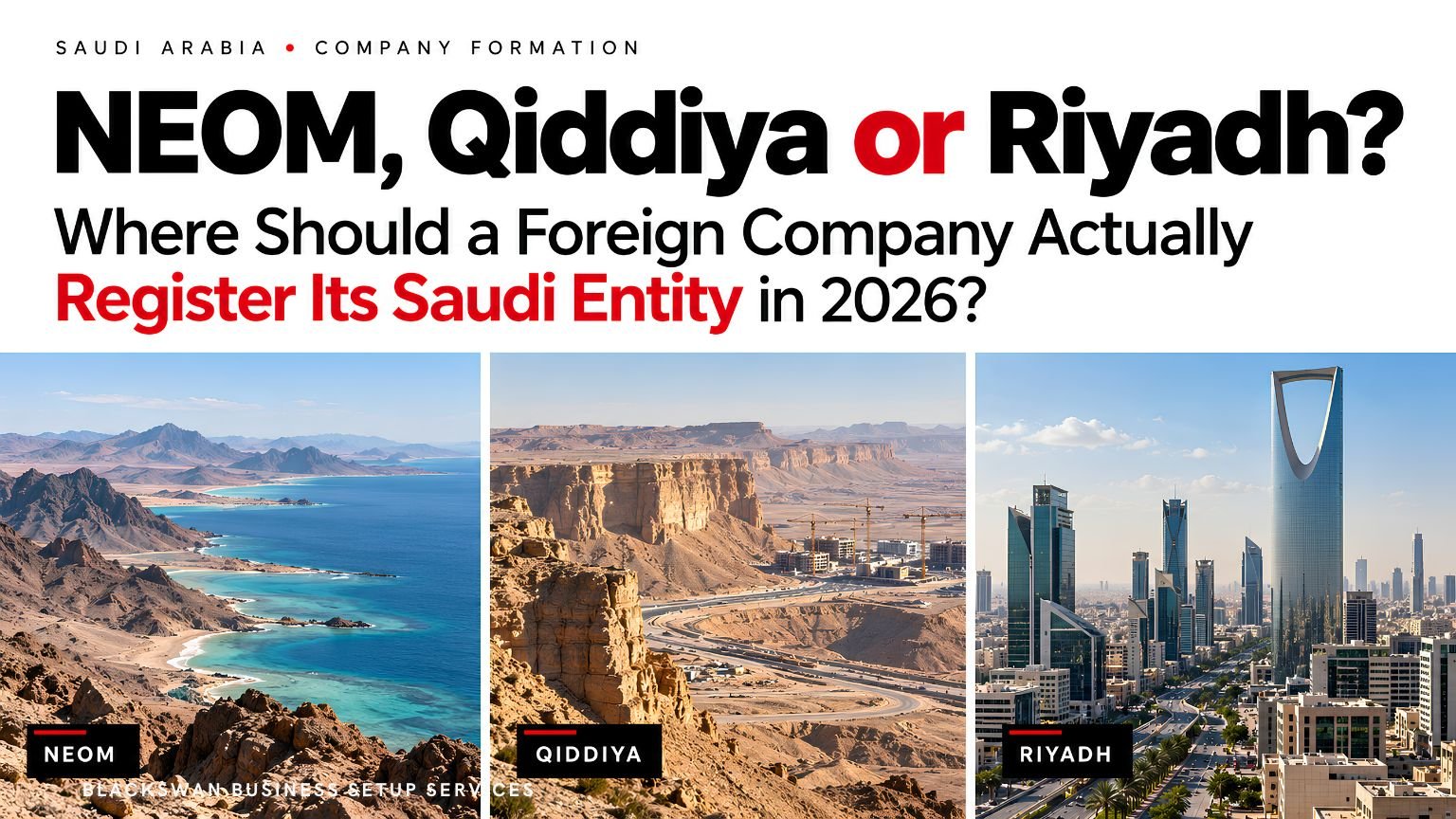
Every time a giga-project hits the headlines, the same emails start arriving. “We want to set up in NEOM.” “Can we register in Qiddiya?” We understand why. These projects sit right at the centre of Vision 2030, and being near the work feels like being near the money.
The catch is that where your company works and where it’s registered are separate questions. In 2026, whether you’re after NEOM work, Qiddiya work or Riyadh business, the answer to where to register usually begins in the same city. Below we explain why, using the facts on each option as they stand right now.
Table of Contents
How registration really works
Setting up a foreign-owned company in Saudi Arabia comes down to two main steps.
First, investor registration with the Ministry of Investment (MISA). This replaced the older licensing model once the Investment Law came into effect in 2025. Most people still call it the “MISA licence” anyway.
Second, Commercial Registration (CR) with the Ministry of Commerce. After that come municipal, tax, labour and sector approvals.
Your CR lists a registered address in a Saudi city. That address doesn’t restrict where you can deliver contracts. A company registered in Riyadh can take on projects anywhere in the Kingdom, as long as it holds the licences its activities need.
NEOM in 2026: what’s different now
NEOM is still a real place, and things are still happening there. It just isn’t the same project it was in 2022.
In January 2026, the Financial Times and other outlets reported that NEOM was being significantly scaled back and redesigned after a year-long internal review. Construction on The Line has reportedly been on hold since around September 2025 while that strategic review plays out. The 2029 Asian Winter Games, which were meant to take place at NEOM’s Trojena, have been postponed. Attention has moved towards industrial and digital uses such as data centres, and energy projects in the Oxagon area have kept going.
So what does that mean for registration? Think of NEOM as a client and a work site rather than somewhere you’d normally register a new commercial entity. Companies that supply NEOM usually register a Saudi entity elsewhere, then meet NEOM’s own supplier and access requirements for working on site.
Qiddiya in 2026: up and running
Qiddiya City lies in Riyadh Province, south-west of the capital, and it has moved well past the drawing board.
Six Flags Qiddiya City opened on 31 December 2025, making it the development’s first operational asset. Aquarabia, the water park, followed in April 2026. Qiddiya Investment Company is still building out entertainment, sports and cultural assets, and transport links to Riyadh are planned.
So what does that mean for registration? Qiddiya is part of the Riyadh region. If you’re providing services, equipment or operations there, a Riyadh-registered entity usually makes the most sense, both on the map and on paper.
Why most foreign companies start in Riyadh
Riyadh is where the people who make decisions are based. That includes the ministries, the Public Investment Fund, many of the giga-project development companies and a big share of corporate buyers.
The Regional Headquarters rule
Since 1 January 2024, Saudi government entities have, in principle, stopped signing contracts with foreign companies that don’t have a regional headquarters in the Kingdom, with some exceptions. Alongside the rule, Saudi Arabia announced incentives for qualifying regional headquarters. One of them is a 0% corporate income tax rate on qualifying RHQ activities for 30 years.
If government or government-linked contracts are part of your growth plan, and most giga-project work falls into that bucket, think about the RHQ question early.
A packed events calendar
Riyadh will host World Expo 2030, and Saudi Arabia is hosting the 2034 FIFA World Cup. Both are confirmed, and both are pushing procurement in construction, hospitality, technology and services.
Special Economic Zones: the option people forget
In January 2026, Saudi Arabia’s Council of Ministers approved detailed regulatory frameworks for four Special Economic Zones. They came into force on 16 April 2026.
| Zone | Location | Focus sectors |
|---|---|---|
| King Abdullah Economic City (KAEC) | Makkah Province, Red Sea coast | Automotive supply chain, electronics, pharmaceuticals, logistics, consumer goods |
| Ras Al-Khair | Eastern Province | Shipbuilding, rig platforms and maritime MRO |
| Jazan | Jazan Province | Food processing, metals conversion, logistics |
| Cloud Computing SEZ | Riyadh-based, can operate nationwide | Data centres and cloud services, with headquarters required in Riyadh |
Depending on the zone and the activity, incentives may include lower corporate income tax for qualifying activities, deferred customs duty and VAT relief on goods inside the zone. An SEZ is worth a look when your activity lines up with the zone’s sector focus. It isn’t meant to be an all-purpose base for a consultancy or a trading business.
So where should you register?
Consulting, engineering or services for giga-projects. Riyadh is usually the best base.
Bidding for government or semi-government contracts. Riyadh, with an RHQ plan in place.
Supplying or operating at Qiddiya. Riyadh.
Supplying NEOM projects. A Saudi entity in a major city, plus whatever NEOM requires of its suppliers.
Manufacturing in a targeted sector. The KAEC, Ras Al-Khair or Jazan SEZ, or a MODON industrial city.
Running a data centre or cloud operation. The Cloud Computing SEZ, with your headquarters in Riyadh.
Retail, hospitality or consumer services. Whichever city your customers live in.
Mistakes we keep seeing
A lot of companies pick a location because of the headlines rather than the contract. Register where your clients and your approvals are. Others forget about Saudization, but Nitaqat quotas follow you wherever you register. Some assume a single licence covers everything, when sector approvals still apply in every city. And plenty leave the RHQ question until after a tender, when it’s far easier to plan for it from the start.
Talk to people who are on the ground
We help foreign companies with MISA registration, Commercial Registration, visas and ongoing compliance right across the Kingdom. Black Swan Business Setup Services runs its Saudi branch from 184 HQ Offices, Al Wurud, Riyadh, and our group headquarters is in Citadel Tower, Business Bay, Dubai. Tell us your activity and who your target clients are at info@blackswanbss.com or on +971 56 658 2477. We’ll give you a straight answer on where your entity belongs.
The bottom line
A lot of the work is in NEOM and Qiddiya. Most foreign companies, though, should be registered in Riyadh. Add a Special Economic Zone if your activity fits its sector, and if government contracts are on the cards, plan your RHQ early.
Sources: Euronews on NEOM’s scale-back · The New Arab on the FT report · Qiddiya City (Wikipedia) · KPMG on the SEZ frameworks · Legal 500 on SEZ entry into force
FAQs
Can a foreign company register its entity inside NEOM?
Most suppliers register in a major Saudi city and then meet NEOM’s own supplier requirements to work on site.
Is Qiddiya part of Riyadh?
Yes. Qiddiya City is in Riyadh Province, so a Riyadh-registered entity usually works well for Qiddiya projects.
What is the Regional Headquarters rule?
Since 1 January 2024, government entities have generally contracted only with foreign firms that have an RHQ in Saudi Arabia.
Are Saudi Special Economic Zones open now?
Yes. The frameworks for KAEC, Ras Al-Khair, Jazan and the Cloud Computing SEZ came into force on 16 April 2026.
Do I still need MISA if I register in Riyadh?
You do. Foreign investors register with the Ministry of Investment before getting a Commercial Registration.