
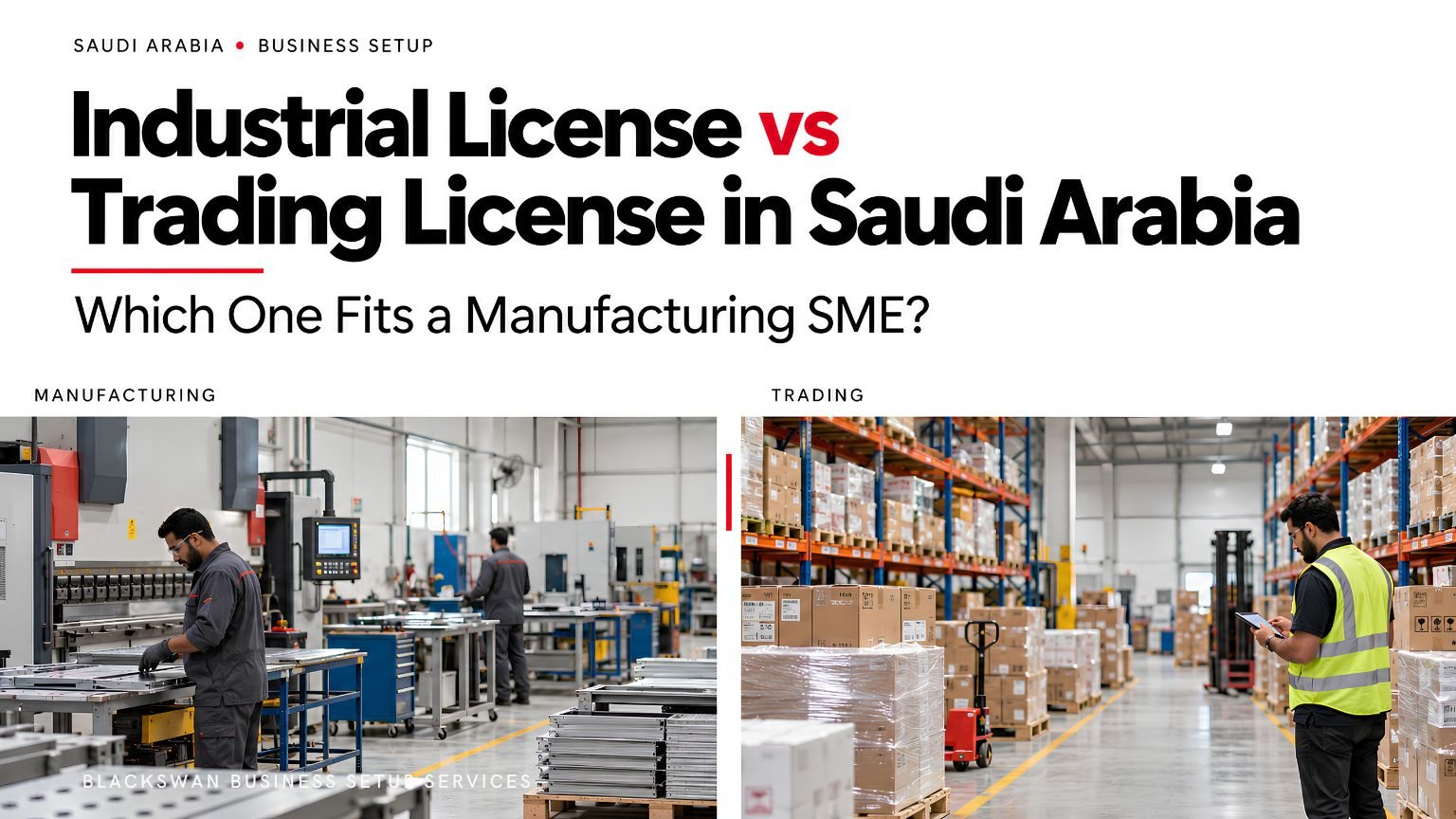
Picture a small manufacturer in India, Turkey or somewhere in Europe weighing up Saudi Arabia. The case looks easy. The domestic market is big, the government strongly backs local production, and many product categories now rely less on imports. Then the first real question lands on the table: do we need an industrial licence or a trading licence?
It looks like paperwork. It’s much more than that. Your answer shapes how much capital you’ll need, where you’re allowed to operate, which incentives you can tap into, and whether the whole plan holds together. This guide looks at that choice purely from the point of view of a manufacturing SME.
Why the Kingdom wants you making things here
Under Vision 2030, Saudi Arabia launched the National Industrial Development and Logistics Program (NIDLP) in 2019 to grow industry, mining, energy and logistics. The “Made in Saudi” programme runs alongside it to promote products made in the country. On top of that, local content rules favour local production in a lot of government procurement.
For a manufacturing SME, the message is simple. The Kingdom isn’t only happy for you to sell here. It actively wants you to produce here.
The two licences, without the jargon
Industrial licence. This covers manufacturing, assembly, processing and industrial production. As a foreign manufacturer, you’ll usually need two separate approvals:
- Investor registration with the Ministry of Investment (MISA) under the industrial category. This creates your foreign-owned company.
- An industrial licence from the Ministry of Industry and Mineral Resources (MIM). This registers the factory itself as an industrial establishment.
Trading (commercial) licence. This is for importing, distributing, wholesale and retail. It goes through MISA and the Ministry of Commerce, and for foreign investors it’s one of the most tightly regulated categories there is.
How they compare
FactorIndustrial licenceTrading licenceWhat it coversProducing, assembling or processing goodsImporting, distributing, wholesale and retailApproving bodiesMISA plus MIM, with land from MODON or another authorityMISA plus the Ministry of CommerceForeign ownershipUp to 100% in most industrial activities100% possible, but with strict conditionsCapital for 100% foreign ownershipVaries by project; no single published minimum for most activitiesMISA’s investor guide lists SAR 30 million, plus presence in at least three markets and further commitmentsPhysical requirementFactory or industrial premisesCommercial premises or warehouseKey incentivesIndustrial land, financing programmes, customs exemptions on qualifying inputs, local content preferenceMarket access for imported goodsIf you take one thing from that table, make it the SAR 30 million line. That number, more than anything else, is why most manufacturing SMEs end up taking the industrial route.
Getting an industrial licence, step by step
1. Find your site
Most factories are located in industrial cities run by MODON, the Saudi Authority for Industrial Cities and Technology Zones. MODON provides developed industrial land, and in many cities it also has ready-built factories that an SME can lease instead of building from scratch. You can also look at the Royal Commission areas of Jubail and Yanbu, or the Special Economic Zones whose frameworks came into effect in April 2026. KAEC, for instance, is aimed at automotive, electronics and pharmaceuticals.
2. Register with MISA
This is where the company is formed. Your investor registration sets out what the business does and its foreign ownership.
3. Get the MIM industrial licence
Your factory, your products and your production plan go onto the national industrial register at this stage.
4. Clear the remaining approvals
You’ll still need environmental permits from the National Center for Environmental Compliance, civil defence approval, municipal permits and labour registration.
Can you sell what you make?
You can. An industrial licence lets you manufacture your own products and sell them. Where it usually stops is importing other companies’ goods and reselling them as a separate line of business. If you want to sell imported products next to your own, you’ll need the relevant trading activity, and that part of the business then falls under the trading rules.
Which route fits your plan?
You’ll manufacture locally for the Saudi market. The industrial licence is usually the answer.
You’ll assemble products from imported components. Usually industrial too, as long as MIM treats your process as industrial.
You’ll import finished goods and distribute them. That’s a trading licence, along with its capital requirements.
You want to import first and build a factory later. It’s often smarter to start with a local distributor, then apply for an industrial licence when you’re ready to produce.
You’ll manufacture and also sell some imported products. You’d typically need the industrial licence plus the relevant trading activity.
You’re looking at contract manufacturing with a Saudi partner. It depends on how the deal is structured, so take advice before you sign anything.
Costs and rules you face either way
Saudization (Nitaqat). Every company has to meet Saudi employment quotas set for its sector and size.
Tax. The foreign-owned share of profits pays 20% corporate income tax. The Saudi-owned share pays zakat instead.
VAT. Most goods and services carry 15%.
Ongoing compliance. Expect annual renewals, labour and tax filings, and sector inspections.
Mistakes we see SMEs make
The most common one is going for a trading licence just to “test the market”. With that capital threshold, it rarely makes sense. Another is assuming the job is done once MISA registration comes through, when the MIM industrial licence is a completely separate approval. Some companies lock in land before checking utilities, even though power and water capacity decide whether a factory is viable. And many underestimate Saudization, which shapes your hiring plan from the very first day.
Where we come in
We work through exactly this decision with SMEs on a regular basis, covering activity selection, MISA registration, MIM licensing, MODON site applications and visas. Black Swan Business Setup Services runs its Saudi branch from 184 HQ Offices, Al Wurud, Riyadh, and the group is headquartered in Citadel Tower, Business Bay, Dubai. Send us your product list and production plan at info@blackswanbss.com or call +971 56 658 2477. We’ll work out which licence fits before you put any capital in.
The short version
If you’re a manufacturing SME, start with the industrial licence. It nearly always makes more sense. You get full foreign ownership in most industrial activities, access to MODON land and industrial incentives, and you avoid the SAR 30 million hurdle that comes with a 100% foreign-owned trading company.
Sources: MISA investor guide conditions for trading, summarised by i-MBS · KPMG on the Special Economic Zone frameworks
Capital thresholds and licence conditions can change. Check the current MISA and MIM requirements before you apply.
FAQs
Can a foreigner own 100% of a factory in Saudi Arabia?
Yes, in most industrial activities. You’ll need MISA registration and an industrial licence from MIM.
How much capital does a 100% foreign-owned trading company need?
MISA’s investor guide lists SAR 30 million, along with presence in at least three markets and other commitments.
What is MODON?
It’s the Saudi Authority for Industrial Cities and Technology Zones. It provides industrial land and ready-built factories.
Can I sell my own products with an industrial licence?
Yes. Reselling imported goods made by others usually needs a separate trading activity.
Does Saudization apply to factories?
It does. Nitaqat quotas apply to every company, depending on sector and workforce size.